Skip to content

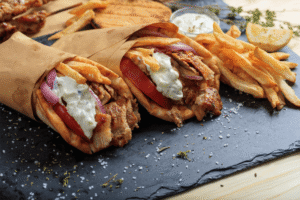
You’ve spotted it on menus a hundred times. That stacked, seasoned meat, wrapped up warm in a soft pita, loaded with sauce and fresh veg. Maybe you’ve ordered one before. Perhaps you’ve just pointed at the menu and hoped you said the name right.
So what is a gyro, really? And how do you even say it? (It’s YEE-roh, by the way. Now you’re ahead of most people.) Let’s clear it all up, then talk about what makes a good gyro great.
What Is a Gyro, Exactly?
A gyro is a Greek street food, and it’s been a favorite for a long time. The name comes from a Greek word that means “turn” or “rotation”. That’s a little clue about how it’s made.
The meat cooks on a tall, spinning spit called a vertical rotisserie. Picture a stack of seasoned meat standing upright, turning slowly next to a heat source. As the outside cooks, someone shaves off thin slices with a long knife. Those warm, tender pieces go straight into a pita while the rest keeps cooking. Nothing sits around getting cold.
You’ll find gyros made with a few different proteins. Chicken and beef are common. Lamb shows up a lot, too, especially at more traditional spots. Each one brings its own flavor, but the idea stays the same every time: seasoned meat, cooked slow, sliced thin, and served warm.
Traditionally, a gyro is street food you eat on the go. It’s wrapped up tight so you can hold it in one hand and keep walking. These days, you’ll also see it served open on a plate, next to rice or fries. Either way works. It’s the kind of food that fits a quick lunch or a full sit-down meal.
What Makes a Gyro Great
Not all gyros are the same. A great one comes down to a few simple parts working together. Get each one right, and the whole thing sings. Miss on even one, and you feel it. Here’s what to look for.
The Meat
This is the heart of the gyro. Good gyro meat is seasoned well, with herbs and spices you can actually taste, not just salt. It should have a little char on the edges for flavor, but stay juicy and tender inside. That balance is fundamental.
Dry, bland meat is the fastest way to ruin a gyro. So is meat that’s been sitting out too long. Fresh and well-cooked makes all the difference, so you can taste it in the very first bite.
The Pita
The pita does a big job, even though it’s easy to overlook. It has to be soft and warm, so it folds without cracking. It also needs to be sturdy, though. A good pita holds all that meat, sauce, and veg without falling apart in your hands halfway through.
Warm it up right, and it almost hugs the filling. A cold, stiff pita is a letdown before you even take a bite. The bread is more important than you might think.
The Sauce
Sauce ties everything together. The classic choice is tzatziki, a cool and creamy blend of yogurt, cucumber, and garlic. It’s tangy, light, and fresh, and it balances out the rich meat.
Some places go with a smooth garlic sauce instead, which is bolder and a little richer. Both are great. It really just depends on what you’re in the mood for that day. A good gyro spot will do its sauce well and not skimp on it.
The Fresh Toppings
Here’s where balance comes in. Crisp lettuce, ripe tomato, and a little raw onion add crunch and brightness to every bite. They cut through the rich meat and creamy sauce, so the whole thing feels fresh instead of heavy.
Skip the veg and a gyro can feel one-note. Add it, and everything wakes up. Good toppings are the subtle part of a great gyro, but you’d miss them the moment they were gone.
Gyro vs. Shawarma — What’s the Difference?
People mix these two up all the time, and it’s easy to see why. Both cook meat on a vertical spit. Both get shaved thin and wrapped up warm. But they come from different places, and they taste different, too.
The gyro is Greek. Its seasoning includes Mediterranean herbs like oregano, and it usually comes with tzatziki and fresh veg. The flavor is bright and herby.
Shawarma comes from the Middle East. The spice blend is warmer and deeper, with things like cumin, coriander, and cinnamon in the mix. The sauce also changes. It’s often a sesame paste called tahini, or a whipped garlic sauce called toum.
So, think of gyro and shawarma as cousins, not twins. Same cooking method, different roots and flavors. Once you know what to look for, you’ll spot the difference every time.
Why Chicken Maisón’s Gyro Is Worth the Drive
Here’s where we come in. We’ve been making fresh Mediterranean food for about 20 years, and our gyro is a favorite for good reason.
We start with fresh grilled chicken. It isn’t sitting on a spit all day under a heat lamp waiting for an order. We grill it fresh, so it stays juicy and full of flavor right up until it lands in your pita.
Every gyro is made to order. That means it comes together the moment you ask for it, never soggy, never sitting around losing its warmth. You get soft pita, tender chicken, our house sauce, and crisp, fresh veg, all built for you on the spot.
That’s really our whole thing. Fresh ingredients make a better meal, and a gyro is the perfect proof. Every simple part is done with care, and you can taste that care in every bite.
Come Taste the Difference
A gyro is simple food done right. Good meat, warm bread, cool sauce, fresh veg. When each part is fresh and made with care, it turns into something you’ll happily drive across town for.
We’d love for you to try ours and see what the fuss is about. Come sit down with us, grab it to go, or have it delivered to your door. With locations across the South Bay and Orange County, from Torrance to Fountain Valley, there’s a good chance we’re closer than you think.
Ready to see what all the hype is about? Order our gyro online or find a Chicken Maisón near you and taste the difference it makes.